
You reread the email four times before sending it. You've rewritten this text twice. There's a project you haven't started because you can't start it right, and a dream you haven't chased because what if you're not immediately excellent at it. From the outside: impressively high standards. From the inside: a cage with really nice bars.
This is online therapy for women who've been praised their whole lives for being perfect and are quietly exhausted by the job of maintaining it.
Online Therapy For Perfectionists in PA & NJ
Are you struggling with perfectionism?
Getting it right doesn't make you happy. You hit the standard, feel relief for a minute, and then the standard quietly moves. It always moves. You never actually reach enough. There's just the next thing you could have done better, waiting for you before you've even finished the last one.
And it doesn't always look like polished spreadsheets and color-coded calendars. A lot of the time it looks like paralysis. You won't start the project because you can't promise it'll turn out great. You won't take the risk because failing in front of people feels unbearable. You don’t plan that dreamy vacation because you already know you can’t commit to doing it “right.”
So the work stays half-done, unlaunched, parked behind some future version of you who's finally ready. Perfectionism can make you overwork, and it can also stop you before you begin.
This was never really about high standards. It's about what you're afraid it says about you if you come up short of flawless.
At its core, perfectionism runs on fear: fear of what falling short would mean about you.

Scared to mess up? Why can’t you be your human self?
Perfectionism Masking Shame
Healthy high standards come from abundance. You care about the work, you do it well, you feel good, and when it's finished, it's finished. You get to rest, celebrate, and move on to the next thing. Perfectionism comes from fear instead. Underneath it is a quiet belief that anything less than perfect means you're not safe, not lovable, not enough. At that point the standard stops being about the work. It becomes the price you pay to keep a much older feeling at a distance. It’s a version of fawning, one of the 4 major fear responses (the one where you people please, even if the pleasing is toward yourself).
That older feeling is usually shame. There's a real difference between guilt and shame that's worth knowing. Guilt tells you that you did something wrong, which is fixable and finite. Shame tells you that you are something wrong, which feels global and permanent. Perfectionism grows right on top of that shame. The belief is this: keep the work flawless, and no one gets to see the flaw in you. Do it right and perfect the first time and nothing bad will happen. No one will get mad. So you spend your energy staying ahead of it, materializing in something like obsessively cleaning your home so Mom can’t visit and say anything about the dust. I see you, girl.
Sassy truth: most women who tell me they're "just a perfectionist" aren't in love with excellence. They're afraid of being exposed. That flawless email was never really about the email. It's armor you've worn so long that it became the daily uniform.

YOUR SASSY SHRINK
Who are you when you’re not being judged?
I'm a Licensed Professional Counselor, and a recovering people pleaser. I love when things are perfect. I've spent too many years across from accomplished women like me who somehow found a way to apologize for their own therapy. "Sorry, I don't think I'm doing this right. Am I doing this right?" Babe, there's no rubric. Showing up scared and asking the question anyway is the brave part, and bravery is the only thing this work actually asks of you.
✓ I already like you. There's no gold star to earn here and none to lose, so you can’t “earn” my affection. If you choose to work with me, we’re already aligned.
✓ We meet online, in a confidential, judgment-free space of your choosing. Show up as you are because I show up as me (no make up, straight from the gym, in a sweatshirt; do you!)
✓ You get therapeutic TLC built for what you need because none of this shit is perfect. It’s just going to be right for you.
What you can expect from me:
We trace where flawless = safe first got wired into the bod and brain. It isn't simply who you are. We separate the genuine care you have for your work, which is lovely and you get to keep it, from the fear-driven compulsion strangling it, which you will learn to kick to the curb. And we practice the things perfectionism swears will end the world: turning something in at 90%, letting a mistake stay visible, starting before you feel ready, resting while it's still imperfect, tailoring your expectations for “good enough.”
Some of that happens in session. Some happens through Homeplay, small doable practices between sessions that let you experiment with "good enough" in low-stakes situations and watch the sky stay up. (Homeplay, not homework, precisely because you do not need one more thing to be graded on.)
Pricing
Affordable rates; No hidden costs; Discounted packages

One-on-one therapy sessions
Our online anxiety therapy sessions are $200 per session. Commit to your goals and save up to 20% with packages of 10-20 sessions.

Molded and made.
You weren't born a perfectionist. You were rewarded into one.
Perfectionism is a survival strategy, and a learned one. It took root early in an environment where being “perfect” was how you stayed safe, loved, or noticed. Whatever the f*ck perfect means.
Maybe love in your house was conditional, handed out for achievements and pulled back for mistakes, so you learned that flawlessness and doing things “right” was the price of approval and love from your caregivers. Maybe a parent was critical, the kind who met an A-minus with "what happened to the rest of it?", and you died inside, deciding then and there never to get below perfect again. Maybe being perfect was simply how you kept the peace. Give no one anything to criticize, and maybe the house stays calm, the mood stays level, the love stays on.
And here's the thread back to the center of my work. Perfectionism is one of the most common children of the mother wound. When a girl learns that a caregiver's approval hinges on her performance, she doesn't grow out of it. She grows a scorekeeper and carries it to school, to work, into every relationship she'll ever have. That relentless inner critic grading your every move is frequently not your voice at all. It's an inherited one, and it comes with a familiar tone. (The mother-wound piece, the root of so much of this, gets its own page here.)
None of this needed to be capital-T trauma. Usually it's a thousand small moments, praise that only showed up for winning, a sigh at anything less than your best, repeated so many times that it started feeling like reality itself.
By the time perfectionism is running your life, it no longer feels like fear at all. It feels like discipline, like high standards, like the simple truth of who you are and what the world expects of you. Like a star athlete who isn’t granted the “off” day, as everyone expects perfection with ease. That is what makes it so hard to question, and exactly why it's worth questioning with someone who sees it for what it is.
Common Signs You're A Little Perfectionist
It lives in your to-do list and it lives in your body. Here's what it looks like in the wild:
● "Done" never feels done, as there's always one more pass, one more tweak, one more thing.
● You procrastinate on the things that matter most because if you never really start, you can't really fail; smell like self sabotage?
● A single mistake can hijack your whole day, replaying on a loop while ten things that went right evaporate.
● You'd rather not try than try and suck at it. Being a novice devastates you.
● You rely heavily on others’ opinions to determine something is ready, like the social media post to your 300 followers
● You reread, rewrite, and re-edit low-stakes things even though your body screams like it’s an emergency.
● Delegating is agony because no one will do it to your standard/expectation, so you drown doing it all yourself. You wonder why you have so much shit to do and you’re beyond tired.
● Rest has to be earned through productivity, and even then you feel guilty taking it. Even on vacation, you struggle to chill out because your mind is back at the office, classroom, hospital, etc.
● Criticism doesn't feel like feedback on the work; it feels like a personal attack. You struggle to separate what’s projection, judgment and genuine feedback worth taking.
● You've abandoned hobbies the moment you weren't immediately good at them. Remember tennis, Mahjong, crochet? Have you thrown away some cool potential hobbies?
● Your inner monologue is a coach who only yells, never claps, and never, ever calls it a win. She expects better, more and regularly shames you into thinking you could’ve done better.
If you're experiencing any of these, you’re not the only one. Online therapy and a safe space to explore will help you understand these thoughts and behaviors while giving you the strength and tools to make active change in your life. No one wants to chase perfectionism when it simply doesn’t exist. Let me teach you how to get off that horse and find your own style.
Perfectionism Is a Costume Designer. Its Best Work Is "Impressive."
Perfectionism almost never shows up wearing a name tag that says "fear." It shows up dressed as everything the world applauds.
The over-preparing, the flawless execution, the being The Reliable One who never drops a ball? That's perfectionism insisting that if the output is airtight, nobody can come for you. The paralysis, the procrastination, the unlaunched dream? Also perfectionism — the same fear, just betting that not trying is safer than trying and being seen as ordinary. Both the overwork and the avoidance run the identical quiet formula: if I never let anyone see me be less than perfect, they'll never find out something's wrong with me.
Sassy truth: nothing is wrong with you. You built perfectionism because somewhere, sometime, being human — messy, average, occasionally wrong — wasn't safe. So you became flawless to survive, and it worked, and it's exhausting, and you're allowed to be tired. We're not going to bulldoze the strategy with more pressure and more grading. We're going to thank it for its service, let it retire, and build something it never allowed underneath: self-trust, and the radical idea that you're worthy on a day you did absolutely nothing impressive.
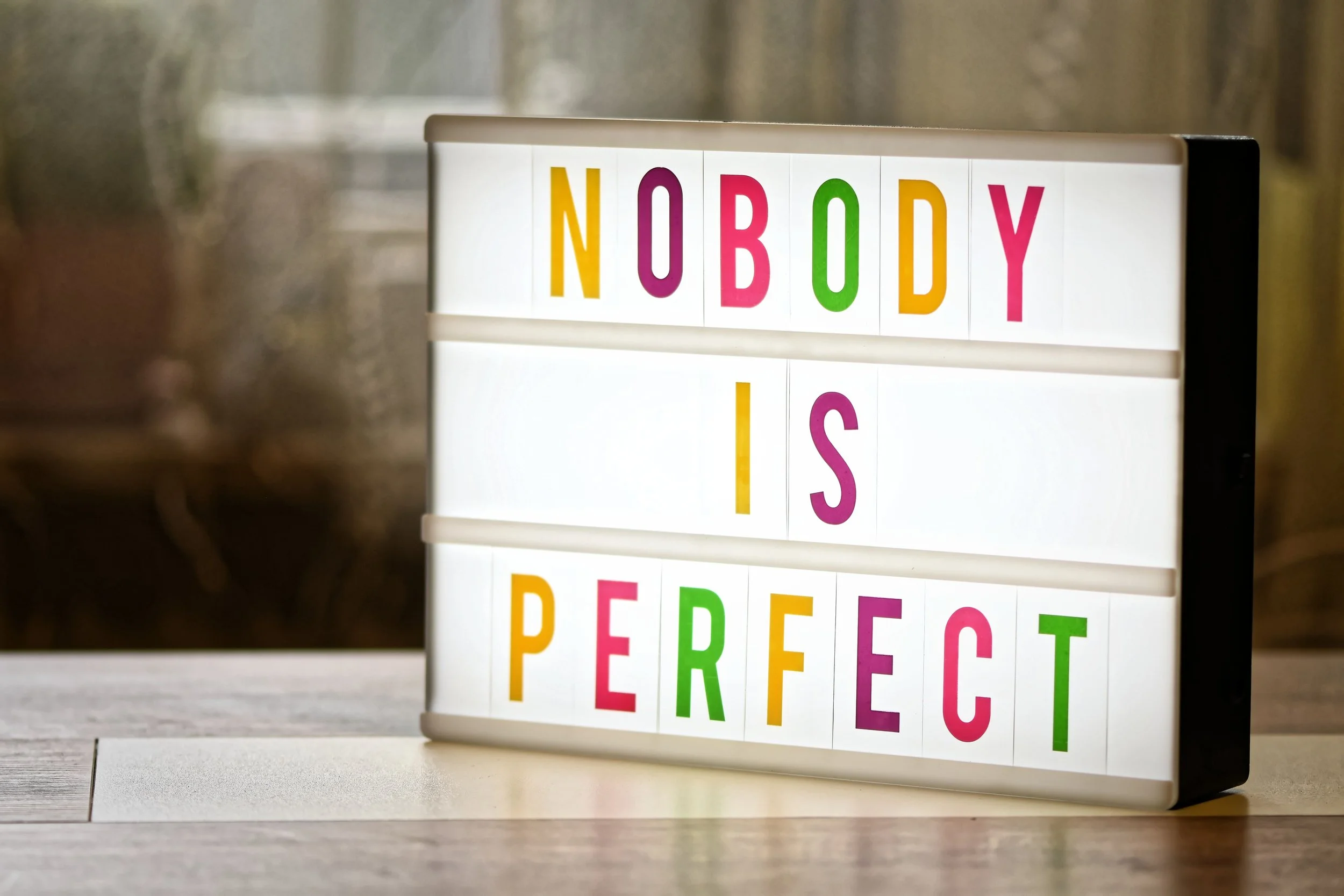

You are allowed to be you. You are already good enough and perfect as is.
Perfect doesn’t exist, Sassy girl.
You've spent your whole life chasing a bar that moves the second you touch it, believing that if you could just get there, you'd finally feel okay. Salvador Dali, the wickedly talented painter, said “have no fear of perfection, for you will never achieve it.” Smug bastard, I think he was right!
The goal isn't to stop caring or lower your standards into the dirt. It's a different relationship with "good enough." Perhaps one where a mistake is a normal human event, not evidence against your character, and where you can make something imperfect and still, somehow, be fine.
Next time the "it's not good enough yet" voice winds up, ask it one question: would I hold someone I love to this standard? If the answer is no — and it's always no — congratulations, you just caught perfectionism in the act. You don't have to argue with it. Just notice the gap between the grace you'd give anyone else and the impossible ruler you save for yourself. That gap is the shame. And every time you see it, it loosens.
Ready to find out what "good enough" actually feels like?
Therapy for Perfectionism FAQ
-
We meet virtually via video or phone from wherever you are in New Jersey or Pennsylvania. Together we trace where "perfect equals safe" got installed, separate healthy care from fear-driven compulsion, and practice tolerating "good enough" in small, real doses until your nervous system stops treating it as danger. Then we build the self-worth that doesn't require a flawless performance to hold you up.
-
The great myth, and the thing keeping you in the cage. You're not successful because of perfectionism — you're successful despite it, and paying in exhaustion, procrastination, and joyless wins. Letting go of the fear doesn't lower your standards; it frees you to meet them without bleeding. High standards can absolutely stay. The terror is what we retire.
-
Caring feels good and has an off-switch — you do your best, it's done, you rest. Perfectionism never clocks out; there's no "done," no rest, and a mistake feels like a character flaw instead of a normal human event. If your standards energize you, keep them. If they punish you and there's no finish line, that's not care — that's fear, and we should talk.
-
Absolutely — same family, different faces. Imposter syndrome whispers you're a fraud, perfectionism is the strategy you built to make sure nobody ever catches you, and anxiety is the alarm running underneath both. We treat the shared root — the shame and shaky self-worth — so you're not white-knuckling three symptoms of one wound for the rest of your life.
-
Def not, nobody's getting subpoenaed. But conditional love and inner scorekeepers are usually born somewhere, so we'll look — gently. Most parents who demanded perfection were handed the same impossible ruler. Understanding where the critic came from is how you prove it isn't the truth about you. We're ending the hand-me-down chain.
-
Because homework is WORK and the last thing a perfectionist needs is one more thing to ace. Homeplay is small, specific experiments between sessions: sending something at 90%, leaving a typo un-fixed, starting before you feel ready, resting without earning it. It's how "good enough" moves from terrifying theory into your actual, livable life.
-
$200 per session or packages of sessions with discounts. We also offer a free consultation call so you can see if we're a fit before spending a dime.
Here's what I actually want for you.
A life where finishing something doesn't cost you a week of dread first. Where you turn in the good-enough version and feel proud instead of nauseous. Where rest doesn't have to be earned, mistakes don't mean anything about your worth, and that scorekeeping voice finally goes quiet enough for you to hear your own.
You don't have to earn your way to okay. You already are. The work is just learning to feel it, and then to live like it's true.
That's what we do together. We take the armor off one piece at a time, at your pace, in a space where nothing you bring is too much and nothing you are is not enough. You get to be a whole person here, not a performance. Messy, brilliant, still-figuring-it-out, and completely worth showing up for.
You've been brave enough to hold it all together for a long time. Let's find out how strong you are when you finally get to set it down.
Not ready to book?
The Heard Woman on Substack is where I write about the stuff that brought you here — the people-pleasing, the anxiety, the relationships that leave you feeling invisible. Start there, see what lands, and when you're ready to go deeper, the call is waiting.
Follow me on Substack: The Heard Woman